Biophysics · Installed November 2026

Mass photometry

Measure the mass of individual biomolecules in solution, label-free, in minutes. The Centre has a Refeyn TwoMP mass photometer with a MassFluidix HC module for micromolar-range samples.

About the technique

Mass photometry detects single molecules as they land on a glass surface and measures how much light each one scatters. That signal is proportional to molecular mass, so a single measurement of a few minutes gives a mass histogram of everything in your sample.

It needs only small volumes at low (nanomolar) concentrations, with no labels, and works for proteins, protein complexes and nucleic acids. It is a quick way to check sample quality, oligomeric state and complex formation before committing to longer experiments.
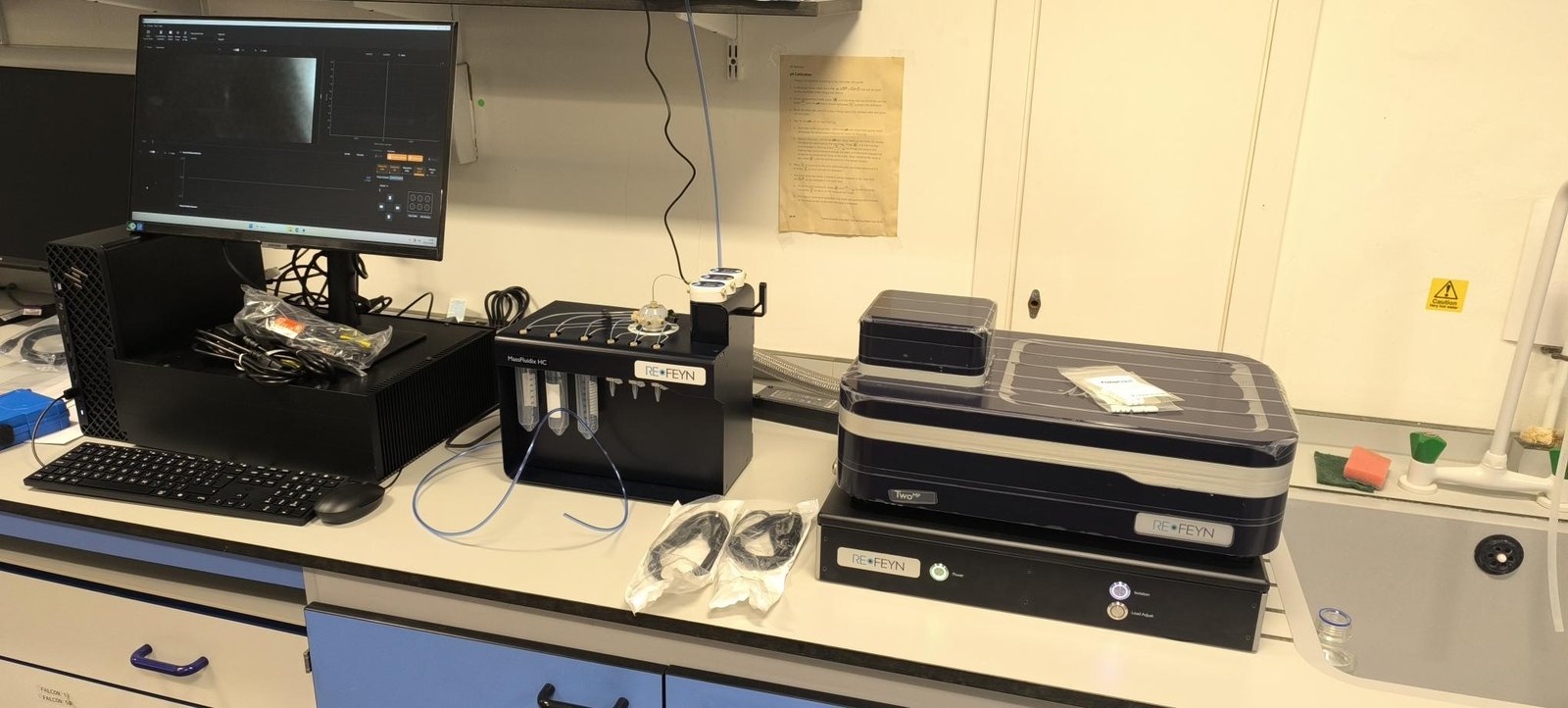
The Refeyn mass photometry setup in lab B16: control computer on the left, the MassFluidix HC unit in the centre and the TwoMP mass photometer on its anti-vibration base on the right.
The mass photometry setup in B16: control computer (left), MassFluidix HC (centre) and the Refeyn TwoMP mass photometer (right).

Instruments

Manufacturer specifications. Contact the Centre Manager to discuss whether your sample suits the instrument.

Refeyn TwoMP

  • Mass range30 kDa – 5 MDa
  • Concentration range100 pM – 100 nM
  • Working volume20 µL
  • Mass resolution (FWHM)25 kDa at 66 kDa; 60 kDa at 660 kDa
  • Mass error± 5% (single measurement)
  • Laser488 nm

MassFluidix HC

  • Sample concentrationup to 50 µM
  • Mass range50 kDa – 5 MDa
  • Dilutionrapid microfluidic, < 37 ms
  • Uselow-affinity and transient interactions

An add-on to the TwoMP that dilutes the sample immediately before measurement, so the complex is captured at micromolar concentration but measured at nanomolar.

Applications

Sample quality

Check purity, heterogeneity and aggregation of a preparation before crystallisation or other experiments.

Oligomeric state

Determine the stoichiometry and assembly state of proteins and larger complexes.

Molecular interactions

Follow protein–protein and protein–DNA interactions and complex formation directly from the mass distribution.

Low-affinity binding

With MassFluidix HC, study weak and transient interactions that only form at micromolar concentrations.

Plan your measurement

Before you start

Email the Centre Manager to discuss your sample, buffer and expected mass range, and to arrange training and booking.

Booking and charges

Check availability in the booking diary. Charges depend on the instrument: see charges.

Contact and location

Protein Crystallography and Biophysics Centre
Institute of Structural and Molecular Biology
School of Natural Sciences, B16
Birkbeck, University of London
Malet Street, London WC1E 7HX
Tel +44 (0)20 3926 3507
Email crystallography@bbk.ac.uk
Contact page · College maps · Malet Street on Google Maps
Member of ARBRE-biophysics
Funded by Wellcome and BBSRC
Wellcome Biotechnology and Biological Sciences Research Council (BBSRC) – UKRI
Partner of the MOSBRI project, funded by the EU Horizon 2020 programme (2021–2025)
European Union